Korea's Stock Market Top Spot Changes Hands: How Did SK Hynix Topple Samsung?
Who would have thought that the "iron throne" of the Korean stock market for the past 25 years would change owners just like that?
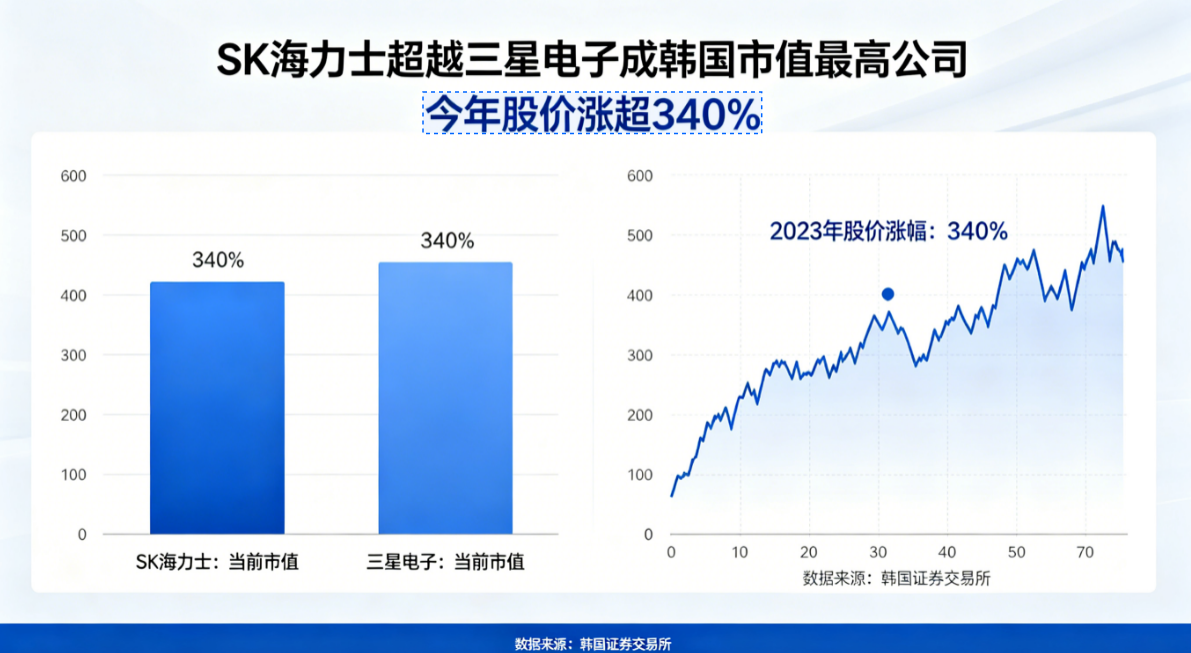
This Monday, SK Hynix shares soared, rising 5.61%, pushing the company's market cap to 2080.37 trillion won (about 1350.98 billion USD), leaving its old rival Samsung Electronics behind. Meanwhile, Samsung Electronics dipped 0.14% that day, with its market cap stuck at 2066.66 trillion won. This rise and fall marked the end of an era—for the first time since 1999, Samsung Electronics lost its position as South Korea's most valuable company.
You might ask: What happened behind this? Did Samsung fail? No, no, it's far more complicated than that.
A "Chip Revolution" Ignited by AI
Let's review the trigger for this "throne change." The answer lies in three words: AI Boom.
Over the past two years, the global wave of artificial intelligence has swept in, from ChatGPT to various large models, all requiring massive computing power. At the core of computing power, besides NVIDIA's GPUs, there is one indispensable component: High Bandwidth Memory (HBM) chips. HBM acts as the "cache" for AI chips, handling massive amounts of data; without it, even the strongest GPUs would stutter.
And SK Hynix happens to be the world's "top player" in HBM chips. Its HBM3 and HBM3E products are eagerly purchased by tech giants like NVIDIA and Google for use in the most advanced AI systems. It can be said that behind every AI storm, there is SK Hynix's "shadow."
The result: SK Hynix's stock has surged over 340% this year, nearly twice the gain of Samsung Electronics (197.7%). It has enjoyed the biggest share of this "AI dividend."
Samsung's "Late Step"
In contrast, although Samsung Electronics is also a global semiconductor giant, it has been a bit slow in the HBM field. Despite stepping up R&D for HBM3E products and even claiming to win big orders from NVIDIA, investors clearly favor SK Hynix based on market reactions.
Samsung's dilemma is somewhat like an elephant trying to turn—its size is too large and its business too diversified. Besides memory chips, Samsung has a host of businesses including smartphones, home appliances, panels, and foundry. Although AI is hot, its boost to Samsung's overall revenue is far less pure and direct than SK Hynix's.
Worse still, Samsung Electronics faces fierce competition from Chinese manufacturers in traditional memory chip markets (such as DRAM and NAND), leading to brutal price wars. SK Hynix's "HBM dividend" is precisely the piece with the highest technical barriers and the most generous profits.
Is It a "Short-Term Overtaking" or a "Long-Term Pattern"?
Some worry that SK Hynix's rise might just be a flash in the pan. After all, Samsung's scale and heritage are undeniable. But the data don't lie: as of Monday's close, SK Hynix's market cap leads Samsung by about 14 trillion won—not a huge gap, but the trend is very clear.
More intriguing is the fact that this "throne change" occurred against the backdrop of both Korean chip giants benefiting from the AI boom. In other words, it's not that Samsung has weakened, but that SK Hynix has accelerated too quickly.
In the long run, as long as the AI wave continues, demand for HBM will keep growing. SK Hynix's technological accumulation and customer relationships (especially its deep ties with NVIDIA) will be hard for Samsung to surpass in the short term. Unless Samsung achieves a "curve overtaking" in HBM technology, the battle for the top spot may have just begun.
Conclusion: Fortunes Shift, AI Decides the Outcome
A 25-year cycle. Samsung Electronics topped the Korean stock market in 1999 and remained unshaken until now. But times have changed; AI has become the new "kingmaker."
SK Hynix's comeback is, on the surface, a fluctuation in stock prices, but in essence, it is a microcosm of industrial change—on the new track of artificial intelligence, whoever seizes the technological high ground can rewrite the market landscape.
For ordinary investors, this is more like a signal: in the next decade, competition in the semiconductor industry will no longer focus solely on "size" but on "technological strength." And SK Hynix, with a brilliant "market cap comeback," has taught all players a lesson.
As for Samsung Electronics, it remains a global tech giant, but losing the top spot in Korea may push it to embrace change faster. After all, on the AI road, no one can stay in their comfort zone forever.
(About 1020 words, original content, easy interpretation of business changes)