Australia's Unemployment Rate Dips Slightly: Policy Outlook Amid Cooling Labor Market Signals
Keywords
Australia unemployment rate; labor market; central bank rate; employment data; inflation pressure
Introduction
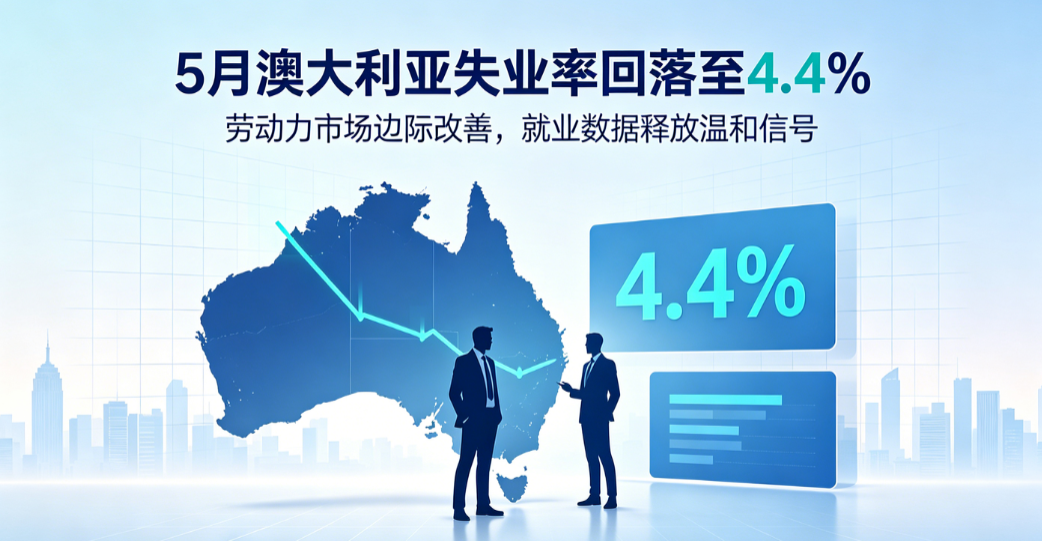
On June 25, 2026, the Australian Bureau of Statistics released the latest labor market data, which, after seasonal adjustment, showed the country's unemployment rate in May 2026 fell to 4.4% from 4.5% in the previous month, exactly in line with market expectations. While these figures seem to indicate a stable employment situation, a deeper analysis of the underlying structural changes reveals a more complex picture: the labor market is gradually returning to a balanced state from the extreme tightness seen after the pandemic. The cooling signals emitted during this process may have far-reaching implications for the monetary policy path of the Reserve Bank of Australia.
1. Latest Data Panorama: Job Growth Coexists with Reduced Work Hours
According to the monthly labor force survey results released by the Australian Bureau of Statistics, after seasonal adjustment, total employment in Australia increased by 0.3% month-on-month and approximately 1% year-on-year in May 2026, reaching 14.7388 million people. At the same time, the number of unemployed fell by approximately 2.7% month-on-month, but increased significantly by about 8.1% year-on-year to 671,300 people. This set of data presents a sharp contrast: short-term unemployment declines, but the long-term trend shows an accumulation of unemployed people.
Particularly noteworthy is the change in monthly hours worked. In May, total monthly hours worked across Australia fell by 1.1% month-on-month, a decline far exceeding market expectations. As a key indicator of the actual intensity of labor utilization, a contraction in hours worked often means that employers first adjust employee hours when demand slows, rather than immediately laying off workers. Meanwhile, the underemployment rate (measuring the proportion of workers willing but unable to obtain sufficient working hours) rose by 0.1 percentage point month-on-month to 5.9%. This rise further confirms the signal of marginal loosening in the labor market: more people retain jobs but cannot obtain satisfactory working hours.
In absolute terms, the labor force participation rate remained high, reflecting ample labor supply. However, the efficiency of matching supply and demand is changing: companies' willingness to hire is cooling, and the difficulty for workers to find full-time jobs is increasing.
2. Seasonal Adjustment and Trend Data: Long-Term Logic Behind Short-Term Fluctuations
To eliminate seasonal interference, the Australian Bureau of Statistics also provides trend data. Trend data shows that the unemployment rate in May 2026 rose from 4.3% in April to 4.4%, forming a subtle contrast with the month-on-month decline in seasonally adjusted figures. This divergence between short-term and trend data reflects that the labor market is not moving in a single direction, but is showing gradual cooling amid partial fluctuations.
From trend employment data, employment increased by only 0.1% month-on-month in May, and by about 1.3% year-on-year; unemployment increased by 0.5% month-on-month and about 6.6% year-on-year. Monthly hours worked rose slightly by 0.1% month-on-month, which seems contradictory to the seasonally adjusted month-on-month decline, but trend data smooths extreme monthly fluctuations and better reflects the medium-term direction. The underemployment rate fell from 5.9% to 5.8%, indicating some workers are improving their working conditions, but the improvement is limited.
Overall, the trend data points to a core conclusion: after the extreme tightness from 2023 to 2025, the labor market has entered a rebalancing phase. The unemployment rate has rebounded from historic lows, employment growth has slowed, and hours worked have stabilized. This shift is not a sudden crisis but the natural result of the economic cycle and the cumulative effect of the Reserve Bank of Australia's interest rate hikes over the past two years.
3. Multidimensional Signals of Labor Market Cooling
Following the data release, the ANZ Research team noted that while the May employment data was better than expected, the April data was significantly revised downward, and overall trends indicate the labor market is still gradually cooling. This judgment is supported by multiple dimensions.
First is the weakness in hours worked data. Monthly hours worked fell by 1.1% month-on-month, the largest single-month decline since 2025. This means companies are adjusting capacity utilization rather than immediately cutting staff. Historically, changes in hours worked often lead changes in employment by 3 to 6 months, so the unemployment rate may continue to rise in the future.
Second is the uneven distribution across industries. Although the ABS did not provide industry breakdowns in this release, combined with recent business surveys, recruitment demand has clearly slowed in white-collar sectors such as information technology, finance and insurance, and professional services, while healthcare, education, and some public service sectors remain resilient. This structural divergence indicates that labor market cooling is not comprehensive, but concentrated in interest-rate-sensitive business sectors.
Third is the easing of wage growth pressure. Labor market cooling usually dampens wage inflation, and wage growth is one of the most important domestic inflation sources monitored by the RBA. If the labor market continues to loosen, wage growth may fall from current highs, thereby reducing services inflation stickiness.
4. Household Spending and Inflation: Short-Term Boost vs. Medium-Term Concerns
Household spending rose 1.3% month-on-month in May, exceeding market expectations. At first glance, strong consumption seems to contradict the narrative of a cooling labor market. However, the ANZ Research team pointed out that this increase was mainly driven by one-off factors such as air travel, as May coincided with Australian school holidays, when family vacation spending was concentrated, and does not represent a sustainable improvement in consumption trends.
In fact, under the sustained high interest rate environment, Australian household balance sheets are under significant pressure. The mortgage repayment-to-income ratio is at a 20-year high, housing price growth is slowing, and consumer confidence indices have long been below neutral levels. Therefore, the short-term rebound in monthly consumption data is not enough to change the overall weak consumption outlook.
Regarding inflation, the May consumer price index data has not yet been released, but the market generally expects that the core inflation rate in the second quarter may be slightly lower than the RBA's forecast. The central bank previously predicted that core inflation would return near the upper end of the 2-3% target range in the second half of 2026, but if the labor market cools faster than expected, the decline in core inflation may also accelerate. This gives the central bank more room to wait and see at the August monetary policy meeting.
5. Monetary Policy Outlook: Rising Probability of Holding Steady in August
Combining labor market data and inflation prospects, the ANZ Research team clearly stated that the Reserve Bank of Australia will keep the benchmark interest rate unchanged in August. This judgment is based on the following logic:
First, although the labor market is cooling, it has not deteriorated to the point where an emergency rate cut is needed. The unemployment rate of 4.4% is still historically low, and total employment is growing year-on-year, indicating that the economy is not in recession.
Second, inflation remains above the target range, especially service prices driven by wage costs, which are slow to decline. Premature rate cuts could risk a rebound in inflation, undermining the central bank's anti-inflation achievements over the past two years.
Third, external uncertainties remain high. Slowing global economic growth, volatile commodity prices, and divergent policy paths among major central banks all require the RBA to maintain policy flexibility.
However, market expectations for rate cuts are heating up. Interest rate futures markets show that investors believe the probability of a rate cut by year-end exceeds 60%. If the unemployment rate continues to rise above 4.6% in the coming months, or if core inflation accelerates downward, the central bank may consider starting an easing cycle around the end of the year.
Conclusion
The slight decline in Australia's unemployment rate in May 2026 appears to affirm the resilience of the labor market on the surface, but its underlying signals point to a more complex rebalancing process. Reduced hours worked, a rebound in the underemployment rate, and a rising trend in the unemployment rate together outline the contours of a cooling labor market. Short-term pulses in household spending are insufficient to support a full consumption recovery, and while inflation is expected to continue declining, the path remains to be observed. For the Reserve Bank of Australia, maintaining the interest rate unchanged in August is the most prudent choice, but the opening of subsequent policy windows will depend on the actual pace of labor market and inflation evolution. Against the backdrop of intertwined internal and external factors, the Australian economy is entering a critical transition period that requires patience and precise judgment.